
Content Analysis Support for Kindai University: Content Analysis of Free-Response Answers Technical support for qualitative content analysis
April 2026
Content Analysis Support for Free-Response Answers (3 Questions)
Integrated Support from Coding and Categorization Through Text Mining and Preparation of a Technical Explanation Report
Content Analysis Support for Kindai University: Free-Response Answers to Three Questions
For free-response answers to three questions commissioned by Kindai University, we provide qualitative-analysis support centered on content analysis. We carefully read the semantic content of each response, conduct coding and categorization according to defined standards, and prepare a technical-explanation-style report to ensure transparency in the analytical process.
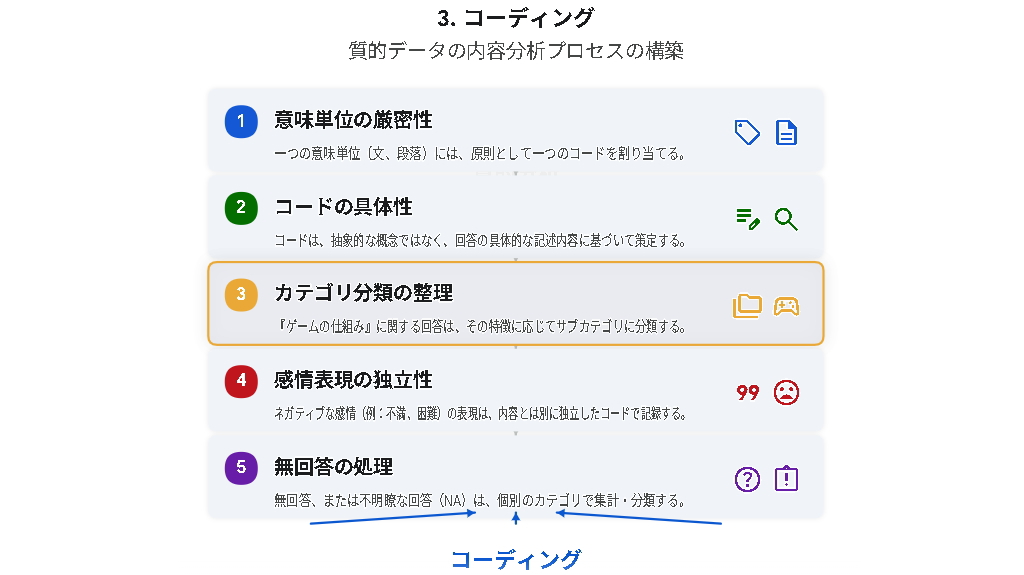
First, for the free-response data being analyzed, we organize coding rules and code definitions to make clear the semantic units to which codes were assigned. This clarifies what each code represents and the criteria by which it was extracted, improving the reproducibility and explainability of the analysis. Beyond simple labeling, we also document the conceptual criteria used to integrate multiple codes as standards for category integration.
The analytical procedure begins with open coding, extracting the main meanings and claims contained in responses and then organizing similar content into categories. Relationships and hierarchy among categories are subsequently examined, with structural organization performed as needed. This reorganizes opinions and perceptions scattered across individual free responses into a research-meaningful category system that makes the overall picture easier to grasp.
In addition to organizing the category system, we also prepare structural diagrams. These visually show relationships between major and subcategories, mutually related issues, and the placement of central and peripheral themes, presenting analysis results in a form that is easier to understand intuitively. This also enables the key findings to be communicated clearly when developing the results into papers, reports, conference presentation materials, and other outputs.
We also use text-mining analysis with tools such as KH Coder to supplement qualitative reading with quantitative and visual perspectives on free-response data. Specifically, frequent-word analysis and co-occurrence network analysis identify which words appear often and which concepts tend to be linked. These findings are compared with content-analysis results to deepen interpretation. This process provides an additional perspective—vocabulary distribution and word relationships—to support manually coded findings.
Analysis results are also visualized through figures and tables. Examples include count tables by category, lists of representative passages, frequent-word lists, and co-occurrence network diagrams. This organizes the findings in a visually and practically accessible format, making the outputs suitable not only for sharing among researchers and developing academic papers but also for use in reports.
Finally, we prepare a technical explanation and summary report on the analysis results. The report includes code definitions, category-classification criteria, analytical procedures, the category system, text-mining results, visualization figures and tables, and technical considerations in the analysis. In other words, this support goes beyond simple tabulation and visualization; its core is a technical-explanation-style report that makes clear the standards used in analysis and the logic by which the results were derived.
We will continue providing integrated support for qualitative analysis and content analysis of free-response answers, structural organization, text mining, and report preparation, contributing to more advanced academic research and practical reporting.
Hashtags
#KindaiUniversity #ContentAnalysis #FreeResponseAnswers #QualitativeAnalysis #Coding #Categorization #CodingRules #KHCoder #TextMining #CooccurrenceNetwork #FiguresAndTables #TechnicalExplanation
Related Information:Statistical Analysis and Data Analysis Services
Related Information:Contact Form
Contact Us
Please feel free to contact us using the information below.
