
Inquiry from Institute of Science Tokyo: Statistical Review Before Journal SubmissionPre-submission statistical review of medical questionnaire research
An inquiry concerning statistical analysis of questionnaire data in a medical or health-related field and a review of analytical decisions and presentation of findings before manuscript submission was received from Institute of Science Tokyo.
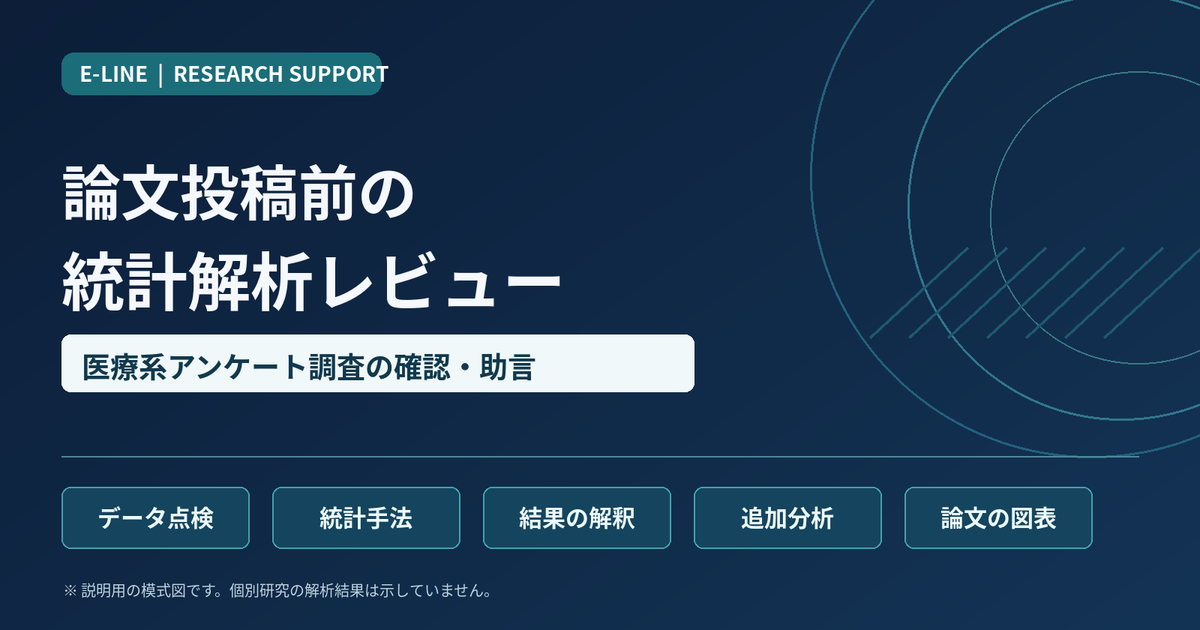
Statistical Analysis Review and Pre-Submission Consultation for Medical Questionnaire Research
Inquiry Overview E-LINE received an inquiry and related data from Institute of Science Tokyo about statistical analyses for a questionnaire study concerning a medical condition and checks before journal submission. Rather than a request solely for tabulation or outsourced analysis, the inquiry concerns reviewing existing statistical results, data handling, analytical methods, and the presentation of findings in a manuscript before submission.
Scope of Disclosure This article does not disclose the medical condition, the names of individual researchers or participants, questionnaire responses, detailed survey instruments, or numerical findings. It introduces an inquiry; it does not imply that an analysis has been completed, that the research results have been established, or that any manuscript has been submitted or accepted. Nor does it imply endorsement or editorial oversight by the university.
Why Pre-Submission Statistical Review Matters
For medical and health questionnaire studies, reliability depends on more than whether statistical software has produced an output. Review may be needed to determine whether analytical methods address the research question, whether missing values and questionnaire scales have been handled appropriately, and whether reported results agree with the analytical outputs.
In this inquiry, the principal issue is to assess the statistical work already conducted and identify whether revisions or clarifications would be justified. The specific procedures and any reanalysis would depend on the study design, variables, source documents, and the target journal's instructions.
Five Areas Considered in a Statistical Review
The following areas describe potential review topics, not analyses already performed or findings reached.
- REVIEW 01Validity of ResultsAgreement among outputs, estimates, and interpretations
- REVIEW 02Data HandlingMissing data, variable definitions, and coding
- REVIEW 03Methods and StrategyFit with study aims and statistical assumptions
- REVIEW 04Further AnalysesWhether extra variables, data, or analyses are warranted
- REVIEW 05Manuscript ReportingConsistency between text, tables, and figures
Figure 2. A conceptual overview of five potentially interrelated review areas; the sequence and extent of any actual review remain to be determined.
| Review area | Items to examine | Reporting considerations |
|---|---|---|
| Statistical results | Consistency of numerical results, estimates, tests, and confidence intervals across source outputs and manuscript | Do statements avoid overinterpretation and reliance solely on statistical significance? |
| Data handling | Variable definitions, coding, missing data, inclusion criteria, and handling of outliers where relevant | Can the data selection and processing procedures be explained transparently? |
| Analytical strategy | Research question, design, measurement scales, distributions, sample size, and model assumptions | Are methods justified and limitations clearly stated? |
| Additional analysis | Potentially missing information, candidate covariates, and need for supplemental analyses | Are additional analyses justified, feasible, and distinguished from prespecified analyses? |
| Manuscript presentation | Consistency of methods, results, discussion, captions, notes, abbreviations, and numeric reporting | Can the reader understand the results without ambiguity, and are journal requirements met? |
Important Considerations When Reviewing Existing Analyses
Statistical validity cannot be judged solely by whether a p value crosses a conventional threshold. The appropriateness of the selected method, effect sizes, uncertainty, missing-data procedures, underlying assumptions, and the definition of the analysis sample all matter. Additional analyses should address a legitimate research question, not be undertaken to obtain more favorable results.
A manuscript's statistical methods section should describe the actual procedures in enough detail to permit scrutiny. This includes, where relevant, variable definitions, tests or models, criteria used, missing-data handling, and statistical software. See the ICMJE Recommendations for general guidance on reporting statistical methods and results.
Checking Consistency Between Text, Tables, and Figures
Even when an analysis is sound, inconsistencies may remain between sample counts in tables and text, numerical estimates and discussion claims, or primary outcomes and exploratory findings. A pre-submission review therefore considers the complete chain from research aim through statistical methods and reported results to the discussion.
Reporting guidelines depend on the study design and journal. For observational studies, STROBE may be relevant, but the design of the inquiry discussed here has not been verified as observational. Applicable guidance should be selected only after the actual design is confirmed.
Privacy and Responsible Data Use
Medical and health research data may contain information that could permit identification when combined. This public article therefore omits individual-level data, identifying details, and the specific medical condition, and limits its discussion to general review topics. Any substantive use of research data should follow applicable ethical and data-handling requirements.
Review Scope Will Depend on the Materials and Study Aims
This article describes the inquiry and receipt of related data. The scope of subsequent consultation would need to be defined by comparing the supplied materials with the research objectives. No conclusion is offered here regarding the need for additional analyses, the statistical findings, or the prospects of journal acceptance.
E-LINE provides consultation for universities and research institutions concerning questionnaire data, analytical strategies, review of statistical results, and the clarity of pre-submission reporting, subject to the specifics of each project.
Frequently Asked Questions
- Q. What is checked in a pre-submission statistical review?
- A. Depending on the materials, checks may address statistical results, data processing, suitability of methods, potential further analyses, and consistency among manuscript text, tables, and figures.
- Q. Can a study be reviewed after the analyses have already been conducted?
- A. Yes. The existing results and manuscript can be examined, with the necessity and feasibility of reanalysis determined by the available data and documentation.
- Q. Are additional analyses always required?
- A. No. The need for additional analysis is assessed in relation to the research objectives and the validity of the existing results.
Reference Resources
- International Committee of Medical Journal Editors (ICMJE): Preparing a Manuscript for Submission to a Medical Journal
- EQUATOR Network: STROBE Statement (for observational studies; applicability to the inquiry has not been determined)
Related Keywords
#InstituteOfScienceTokyo #StatisticalReview #MedicalStatistics #QuestionnaireResearch #ManuscriptReview #StatisticalConsultation #ResearchSupport #ELINE
Related information: Statistical Analysis Services
Related information: Contact Form
Contact Us
Please feel free to contact us using the information below.
