
Statistical Analysis Support for the Center for Dementia Care Research and Practices in SendaiData Preparation, Exploratory and Confirmatory Factor Analysis, and Structural Equation Modeling
E-LINE provided statistical analysis support to the Center for Dementia Care Research and Practices in Sendai, including exploratory factor analysis (EFA), confirmatory factor analysis (CFA), and structural equation modeling (SEM).
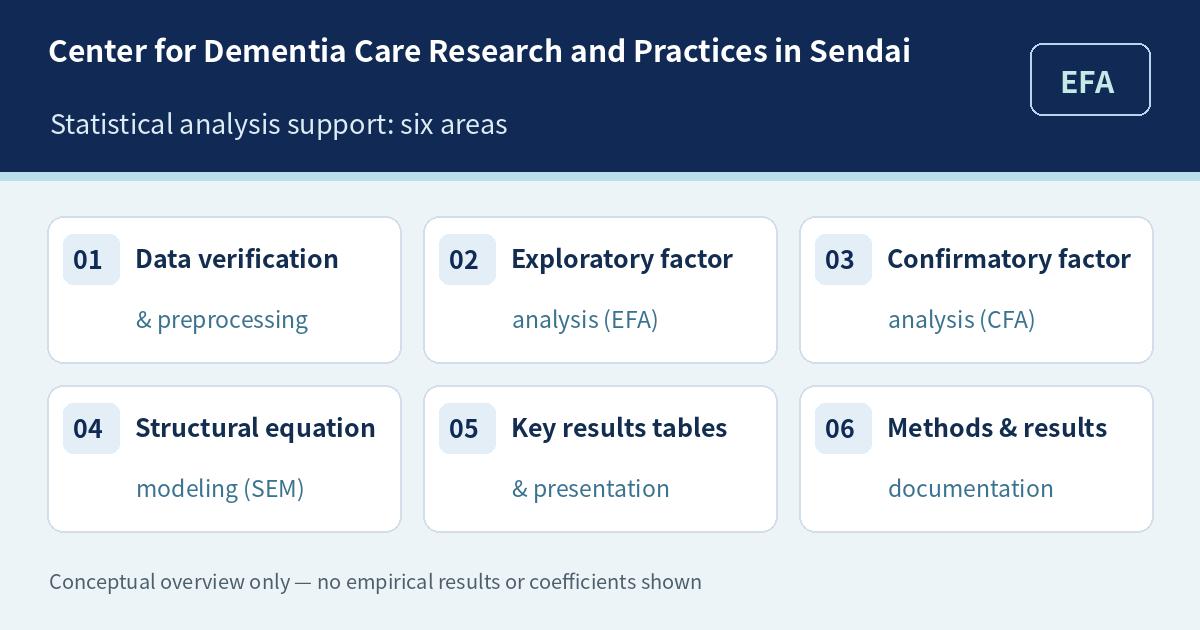
Statistical Analysis Support for the Center for Dementia Care Research and Practices in Sendai: EFA, CFA and SEM
Project OverviewE-LINE Co., Ltd. provided statistical analysis support to the Center for Dementia Care Research and Practices in Sendai. The work covered data verification and preprocessing, exploratory factor analysis (EFA), confirmatory factor analysis (CFA), covariance structure analysis and structural equation modeling (SEM), preparation of key statistical results tables, and organization of the analysis methods and principal results.
Scope of disclosure: This article describes the categories of work delivered. The specific research topic, participants, sample size, variables, factor structures, coefficients, fit indices, research findings, and publication status were not supplied for public disclosure and are therefore not reported. This article does not imply review or endorsement by the Center.
Statistical Analysis and Research Support Provided
The engagement comprised the six areas below. The table explains their general methodological purposes; it does not present findings or a detailed account of the undisclosed study.
| Service area | Work provided | General methodological purpose |
|---|---|---|
| Data verification and preprocessing | Verification and preprocessing of research data | Reviewing the status and treatment of data before statistical analysis |
| Exploratory factor analysis (EFA) | Statistical analysis using EFA | Exploring potential latent factor structures underlying observed variables |
| Confirmatory factor analysis (CFA) | Statistical analysis using CFA | Evaluating how well a specified measurement model fits the data |
| Covariance structure analysis / SEM | Covariance structure analysis and structural equation modeling | Evaluating measurement models and relationships among variables within a model |
| Key statistical results tables | Preparation of major statistical results tables | Organizing analysis outputs in an accessible tabular format |
| Methods and principal findings | Organization of analytical methods and principal results | Documenting the analyses performed and their main results |
Exploratory Factor Analysis (EFA) and Confirmatory Factor Analysis (CFA)
Exploratory factor analysis (EFA) is used to explore latent structures that may account for patterns of association among observed variables. By comparison, confirmatory factor analysis (CFA) evaluates a prespecified measurement model against the observed data. The approaches serve different methodological purposes and should not be treated as interchangeable.
Both EFA and CFA were among the analyses provided in this engagement. However, the number of factors, estimation methods, item composition, factor loadings, and model fit statistics are not disclosed in this article.
Covariance Structure Analysis and Structural Equation Modeling (SEM)
Structural equation modeling (SEM) is a statistical framework for evaluating measurement models involving latent variables and models describing relationships among variables. It is closely associated with covariance structure analysis. The specification and interpretation of any given model depend on the research question and design.
SEM formed part of the support provided. Its inclusion should not be interpreted as proof of causation or confirmation of any specific hypothesis. This article does not infer the model used or the estimates obtained.
Preparation of Results Tables and Documentation of Methods and Findings
Statistical analysis support also involves organizing how methods and results are presented. In this project, E-LINE prepared key statistical results tables and organized the analysis methods and principal results.
The completed tables and numerical findings are not reproduced here. Their detailed content, column definitions, and numerical values have not been supplied for publication.
Statistical Analysis Services for Research Institutions
E-LINE supports research-oriented data verification and preprocessing, factor analysis, structural equation modeling, preparation of statistical results tables, and documentation of methods and findings. Our approach emphasizes consistency between research questions, statistical procedures actually performed, and conclusions supported by the results.
Reference: Center for Dementia Care Research and Practices in Sendai (official website). Information about the Center itself is provided by its official website; the analysis support described here is based on the project information supplied by E-LINE.
Frequently Asked Questions
- Q. What statistical analysis support was provided?
- A. Data verification and preprocessing; EFA; CFA; SEM; preparation of key results tables; and organization of analytical methods and principal results.
- Q. Are the factor counts and statistical findings available?
- A. They are not included in this article. We have not inferred or published any unprovided numerical findings or details about the research dataset.
Related Keywords
#StatisticalAnalysis #ExploratoryFactorAnalysis #EFA #ConfirmatoryFactorAnalysis #CFA #StructuralEquationModeling #SEM #CovarianceStructureAnalysis #DataPreprocessing #ResearchSupport #DementiaCareResearch
Related service: Statistical Analysis and Analytics
Contact: Contact Form
Contact Us
Please feel free to contact us using the information below.
