
Support for Analysis of Short-Term Study Abroad Experience Reports with Waseda University: Examining Explanatory and Evaluation Items to Help Students Select Programs Analytical support for study abroad program evaluation and student-facing guidance
May 2026
Integrated Analysis Support for Short-Term Study Abroad Participant Data
combining quantitative and qualitative analyses, organizing practical insights useful for designing information sessions, evaluation items, and program selection
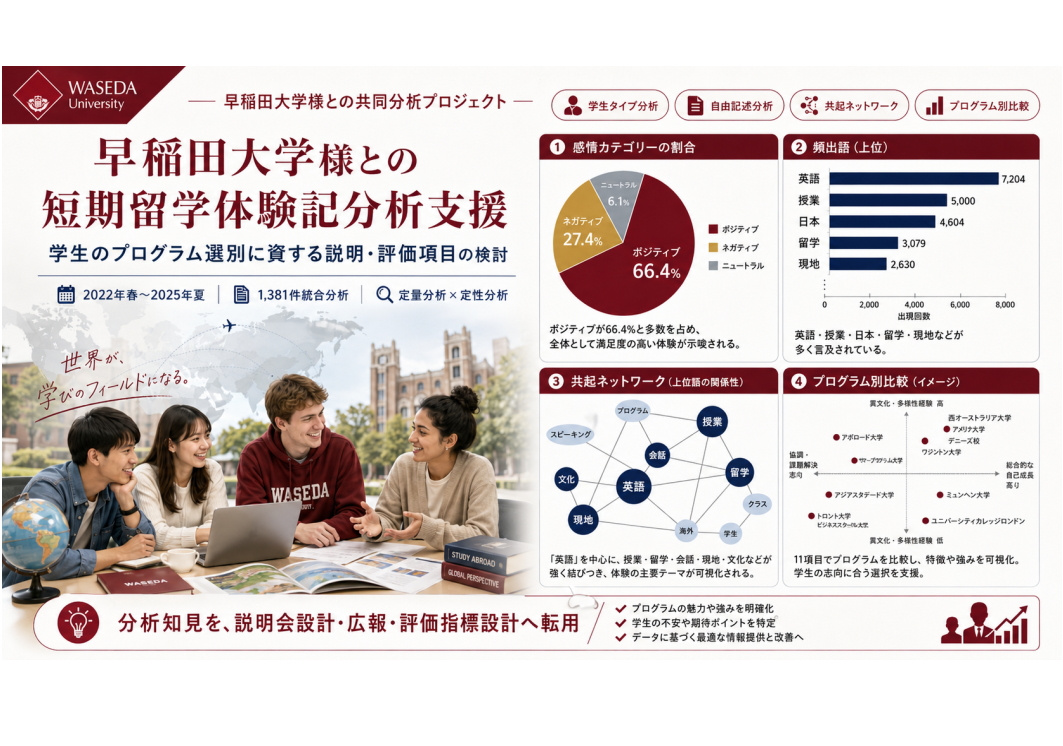
Support for Analysis of Short-Term Study Abroad Experience Reports with Waseda University: Examining Explanatory and Evaluation Items to Help Students Select Programs
Analysis Overview In collaboration with Waseda University, we conducted an analytical project using experience reports and related data from participants in short-term study abroad programs. Rather than merely tabulating satisfaction and participants' sense of growth, this project was designed to help students in the future more easily select programs according to their interests, language-related concerns, growth goals, and preferred local experiences, with the aim of establishing an analytical foundation that supports presentation of explanatory and evaluation items.
Target Data The analysis covered Participant data from short-term study abroad programs from spring 2022 through summer 2025 and integrated participant responses across multiple academic years, organizing them into a format that allows comparison across years and programs. The target data included overall satisfaction, competency evaluation items, reasons for participation, factors affecting program choice, and open-ended responses and other items, enabling a multifaceted understanding of why students decided to participate, what aspects of the experience they valued, and where they felt anxiety or burden.
Quantitative Analysis In this analysis, We combined quantitative and qualitative analyses. On the quantitative side, to identify factors influencing overall satisfaction, Logistic Regression Analysis, to classify students' perceived growth k-means clustering, to visualize characteristics by program Principal Component Analysis and other methods. This enabled us to identify characteristics of different student types and the directions of growth that tend to be associated with different programs, which are difficult to see from simple comparisons of mean values alone.
Qualitative Analysis For the qualitative analysis, open-ended responses were read at the sentence and clause level and their evaluative direction was organized as positive, neutral, or negative. We also conducted structuring of students’ voices using the KJ method, frequent-word analysis, and co-occurrence network analysis. This enabled us to examine, from both quantitative trends and qualitative meaning, how students remembered their short-term study abroad experiences, which situations they found valuable, and what kinds of burdens they experienced in daily life, language use, and psychologically.
Key Findings The analysis confirmed that the value of short-term study abroad cannot be adequately explained by a one-dimensional evaluation of whether language ability improved. Students’ descriptions indicated outcomes such as reduced reluctance to use English, greater initiative while abroad, interaction with multinational students and local people, and broader intercultural understanding and perspective. These psychological and behavioral changes emerged as important forms of value.
Factors Associated with Satisfaction Factors associated with higher overall satisfaction included not only the appeal of the host country and program content, but also the reassurance of participating in a university-provided program, reduced administrative burden, and the ability to participate during a long vacation. Therefore, student-facing explanations should go beyond credits and costs and show concretely where students will go, what they will learn, what experiences they will have, and what kind of growth they can expect.
Student Types In the student-type analysis, participants were organized into students who perceived broad overall growth, students who mainly perceived growth through interaction and intercultural understanding, and students who still had difficulty articulating their sense of growth. Rather than giving every student the same explanation, the findings suggest preparing multiple explanatory dimensions, such as interaction-oriented, language-practice-oriented, self-growth-oriented, and reassurance-oriented information.
Program Comparison In comparing program characteristics, we emphasized clarifying the type of growth and experiential value offered by each program rather than simply ranking programs as better or worse. For example, programs can be organized into dimensions that students can compare when choosing: local-life immersion that tends to foster confidence and independence; discussions and presentations that strengthen thinking and communication in English; multicultural interaction that broadens values and perspectives; and programs, including those in non-English-speaking countries, that tend to develop willingness to take on challenges and initiative.
Long-Term Objective The long-term objective of this project is not only to use the analysis results for student recruitment and information-session materials, but also to present explanatory and evaluation items that students themselves can use as criteria when selecting programs. Specifically, the intended information design covers the host country, program content, class format, opportunities for interaction, living environment, opportunities to use the language, support that provides reassurance, the degree of advance preparation required, and the types of growth students are likely to experience, helping students choose “a program that suits me” more easily.
Evaluation Items Rather than relying solely on overall satisfaction, we identified the importance of combining indicators such as sense of growth, intercultural understanding, respect for others, acceptance of diversity, willingness to take on challenges, self-expression, problem-solving awareness, foreign-language comprehension and conversation, resolution of pre-departure anxiety, adaptation to daily life, and perceived value expressed in open-ended responses. This makes it possible to evaluate short-term study abroad not only in terms of whether students were satisfied, but continuously from the perspectives of “What changes occurred?” and “Which experiences led to growth?”.
Applications Based on the analysis results, we organized the findings so they can be repurposed for recruitment communications, information-session design, program-specific FAQs, pre-departure support, orientation, and post-program questionnaire design. We also considered student-friendly explanatory wording such as “The feeling that I was able to communicate becomes confidence.” “Even a short program can broaden your perspective.” and “There are study-abroad options that are approachable even for first-time participants.”, presenting directions for information that reduces anxiety while supporting independent program selection.
Going forward, based on the insights gained through our analytical work with Waseda University, we will continue to provide integrated support encompassing educational program evaluation, open-ended response analysis, student-type analysis, text mining, preparation of information-session materials, and design of evaluation indicators, contributing to an environment in which each student can select learning opportunities that suit them.
Hashtags
#WasedaUniversity #ShortTermStudyAbroad #ExperienceNarrativeAnalysis #StudyAbroadProgram #StudentSupport #ProgramSelection #EvaluationItems #SatisfactionAnalysis #StudentTypeAnalysis #FreeResponseAnalysis #KJMethod #CooccurrenceNetwork #TextMining #EducationalEffectiveness #AnalysisSupport
Related Information:Statistical Analysis and Data Analysis Services
Related Information:Contact Form
Contact Us
Please feel free to contact us using the information below.
