
Logistic Regression Support for Home End-of-Life Care Research at Shiraha Medical Corporation Multivariable logistic regression support for GDI and end-of-life care satisfaction
Support Case: Home-Visit Medical Care / Home End-of-Life Care / Bereaved-Family Survey / GDI / End-of-Life Care Satisfaction / Multivariable Analysis
Statistical Analysis Support for Research Data on Home End-of-Life Care at Shiraha Medical Corporation
E-LINE Co., Ltd. For a questionnaire survey of bereaved family members of patients who received home-visit medical care, we supported statistical analysis to examine associations between the Good Death Inventory (GDI) and overall satisfaction with end-of-life care. The study period was May 2020 through April 2024. The survey was sent to bereaved family members of 1,857 deceased patients, and 867 responses were obtained.
Multivariable Logistic Regression Support for GDI and End-of-Life Care Satisfaction for Shiraha Medical Corporation
Support Overview In this project, responses from 867 bereaved family members obtained from a questionnaire survey of 1,857 bereaved families The objective was to examine which items of the Good Death Inventory (GDI) were associated with overall satisfaction with end-of-life care, and we therefore supported Multivariable Logistic Regression Analysis statistical analysis using this method. Based on the number of eligible individuals and respondents provided, the survey response rate was approximately 46.7%.
Home End-of-Life Care and Bereaved-Family Evaluations When examining the quality of home healthcare and home-visit medical care, not only patients' clinical information but also evaluations obtained from bereaved family members who experienced end-of-life care are important research data. In this study, the analytical objective was to statistically examine associations between overall satisfaction with end-of-life care and multiple dimensions included in the Good Death Inventory (GDI).
Survey Population and Response Data The survey population consisted of bereaved family members of 1,857 patients who received home-visit medical care from Shiraha Medical Corporation and died between May 2020 and April 2024. A total of 867 bereaved family members responded to the questionnaire. The analysis data provided contained anonymized patient numbers together with satisfaction with end-of-life care and responses to each GDI item.
| Item | Content | Role in the Analysis |
|---|---|---|
| Study Population | bereaved family members of 1,857 patients who received home-visit medical care and died between May 2020 and April 2024 | Examine bereaved-family evaluations of home end-of-life care. |
| Number of Responses | 867 responses | The response rate relative to the number of eligible individuals provided was approximately 46.7%. |
| Explanatory Variables | each item of the Good Death Inventory (GDI) | Examine the independent association between satisfaction with end-of-life care and each GDI item. |
| Outcome Variable | Overall Satisfaction with End-of-Life Care | Treat it as the outcome in a logistic regression model. |
| Analytical Method | Multivariable Logistic Regression Analysis | Consider multiple GDI items simultaneously and examine their associations with satisfaction with end-of-life care. |
| Nonresponse | identified in the data as code 3 | Distinguish it from affirmative and non-affirmative responses and handle it appropriately as missing data. |
| Information Management | Only publicly disclosable research overview information is presented. | Do not disclose individual patient information or unpublished analytical results. |
Structure of the GDI Data In the attached data, Question 1 of the Good Death Inventory (GDI) was recorded as three subitems—pain, physical discomfort, and a peaceful state of mind—followed by Questions 2 through 17. Accordingly, although the questionnaire framework consists of 17 questions, the analysis file contains 19 GDI explanatory-variable items The data were organized in this format. The GDI items consisted of binary data indicating affirmative or non-affirmative responses, together with code 3 identifying nonresponse.
End-of-Life Care Satisfaction Data In the analysis Excel file, overall satisfaction with end-of-life care was organized as binary values together with a nonresponse code. For logistic regression analysis, it is important to define the outcome clearly and specify how nonresponse is handled before constructing the model. To protect unpublished research, this article does not publish individual tabulations of satisfaction or regression-estimation results.
Multivariable Logistic Regression Analysis Logistic regression analysis is a method for simultaneously examining associations between a binary outcome variable and multiple explanatory variables. In this project, satisfaction with end-of-life care was set as the outcome and each GDI item as an explanatory variable, allowing the association between each GDI item and satisfaction to be examined while simultaneously accounting for the other items. Using a multivariable model rather than simple percentage comparisons makes it possible to statistically organize data in which multiple factors coexist.
Handling of Nonresponse Codes The data included code 3 indicating nonresponse for both the GDI and end-of-life care satisfaction. When conducting binary logistic regression, it is not appropriate to treat this code as a continuous numeric value on the same scale as affirmative and non-affirmative responses. The response-category definitions therefore need to be confirmed, nonresponse distinguished as missing, and the analysis sample defined accordingly. The final sample size varies depending on the missing-data treatment and combination of variables included in the model.
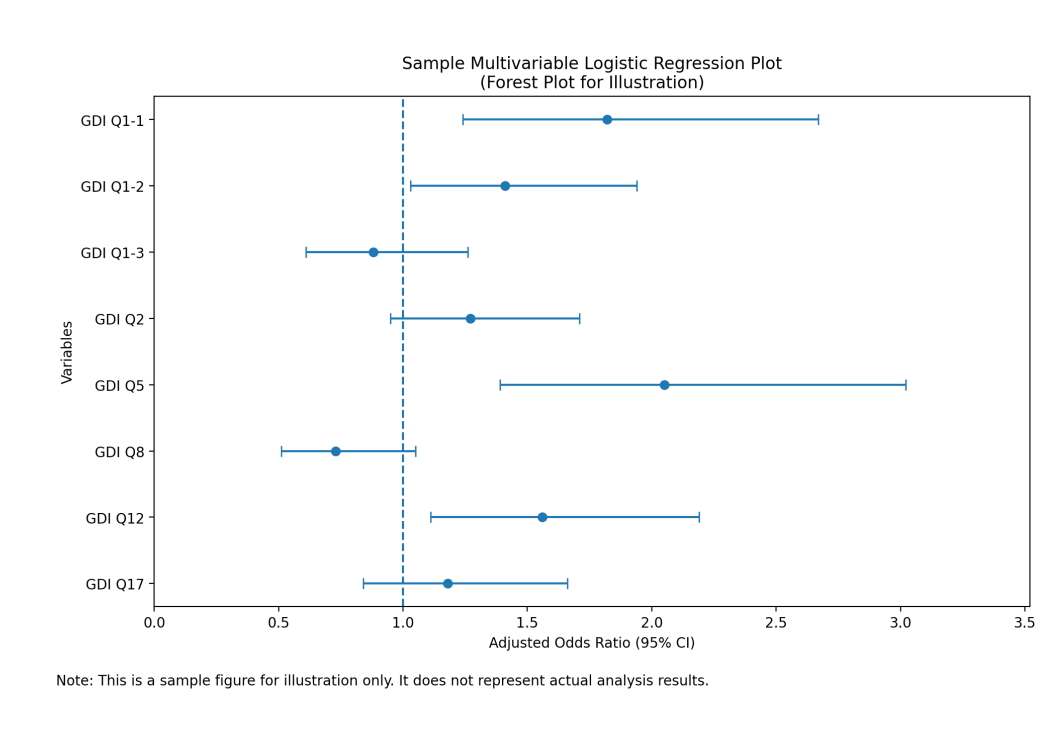
Key Points in Interpreting the Results In multivariable logistic regression, the association with end-of-life care satisfaction can be evaluated for each explanatory variable using odds ratios, confidence intervals, statistical significance, and related indicators. However, because this study uses observational data from a bereaved-family questionnaire, even when a statistical association is observed it cannot by itself establish that a particular GDI item causally increases satisfaction. Careful interpretation based on the study design and data characteristics is important.
Analysis That Can Contribute to Improving the Quality of Home Healthcare The GDI provides multidimensional information on the circumstances in which patients spent the final stage of life. By organizing its association with overall satisfaction with end-of-life care through multivariable analysis, the data can serve as foundational research material for examining aspects of care associated with bereaved-family evaluations in home healthcare and home-visit medical care. At E-LINE Co., Ltd., we consistency among the research objective, variable definitions, missing-data handling, and statistical methods while checking these factors, we support research-data analysis in medical and nursing fields.
Research Ethics and Confidentiality In medical research, appropriate handling of data concerning patients and bereaved family members is essential. This article presents only publicly disclosable facts that can be confirmed from the research overview and analysis data provided. It does not publish information that could identify individual patients, individual-level responses, or unpublished analytical results such as individual odds ratios and p-values.
Acknowledgments We sincerely appreciate the opportunity to support statistical analysis of GDI and satisfaction with end-of-life care in research on home end-of-life care conducted by Shiraha Medical Corporation. E-LINE Co., Ltd. will continue to accuracy, research ethics, and confidentiality We place importance on these principles and will continue supporting research activities in medicine, nursing, welfare, and other fields through statistical analysis.
Summary In this case, we supported statistical analysis of a bereaved-family survey on home end-of-life care conducted by Shiraha Medical Corporation. The survey targeted bereaved family members of 1,857 home-visit medical care patients who died between May 2020 and April 2024, and used 867 responses to examine associations between each Good Death Inventory (GDI) item and overall satisfaction with end-of-life care through multivariable logistic regression. In multivariable analysis for medical research, it is important not merely to run statistical software, but to consistently organize the outcome definition, structure of explanatory variables, handling of nonresponse and missing values, and interpretation of results according to the study design.
Frequently Asked Questions
Q1What data were analyzed in this study?
The data consist of 867 responses obtained from a questionnaire survey of bereaved family members of 1,857 home-care patients who died between May 2020 and April 2024. The analysis covered each GDI item and overall satisfaction with end-of-life care.
Q2What statistical analysis did you support?
We supported multivariable logistic regression with satisfaction with end-of-life care as the outcome variable and each item of the Good Death Inventory (GDI) as an explanatory variable. The analysis was designed to consider multiple GDI items simultaneously and examine the association of each item with satisfaction.
Q3Should the GDI nonresponse code 3 be analyzed as a numeric value as-is?
No. Code 3 indicates nonresponse, so it should not be treated as a substantive response value equivalent to affirmative or non-affirmative responses. It should be distinguished as missing data when designing the analysis. The final analysis sample size varies depending on the variables included in the model and the missing-data treatment.
Q4Can causality be determined from logistic regression analysis?
This analysis can examine statistical associations while considering multiple items simultaneously, but causality cannot be established from observational bereaved-family survey data alone. Interpretation must take the study design into account.
Hashtags
#HomeEndOfLifeCare #LogisticRegression #GDI #EndOfLifeCareSatisfaction #HomeVisits #HomeHealthcare #BereavedFamilySurvey #GoodDeathInventory #MultivariableAnalysis #MedicalStatistics #StatisticalAnalysis #ClinicalResearch #ResearchSupport #ShirahaMedicalCorporation #ELINE
About the content of this page: This article is based on facts that can be confirmed from the survey overview presented when the support was requested and the analysis data provided for research supported by E-LINE Co., Ltd. It does not publish information that could identify individual patients or bereaved family members, individual-level data, or unpublished research results such as individual regression coefficients, odds ratios, and p-values. This article is also not intended to publish the academic conclusions of the study or medical causal relationships.
Related Information:Logistic Regression and Medical Statistical Analysis Support Services
Related Information:Manuscript Editing and Research Support Services
Related Information:Inquiries About Medical and Statistical Analysis
Contact Us
Please feel free to contact us using the information below.
