
Survey Item Development and Analysis Design for Study-Abroad Interest among Waseda University Tutorial English / AWADE Students Survey design and analytical framework for study-abroad interest and intention
September 8, 2026
Study-abroad interest and intention survey design for Tutorial English / AWADE students
A framework to visualize the decision factors that distinguish students who choose study abroad from those who do not, and to support future longitudinal examination and study-abroad promotion measures.
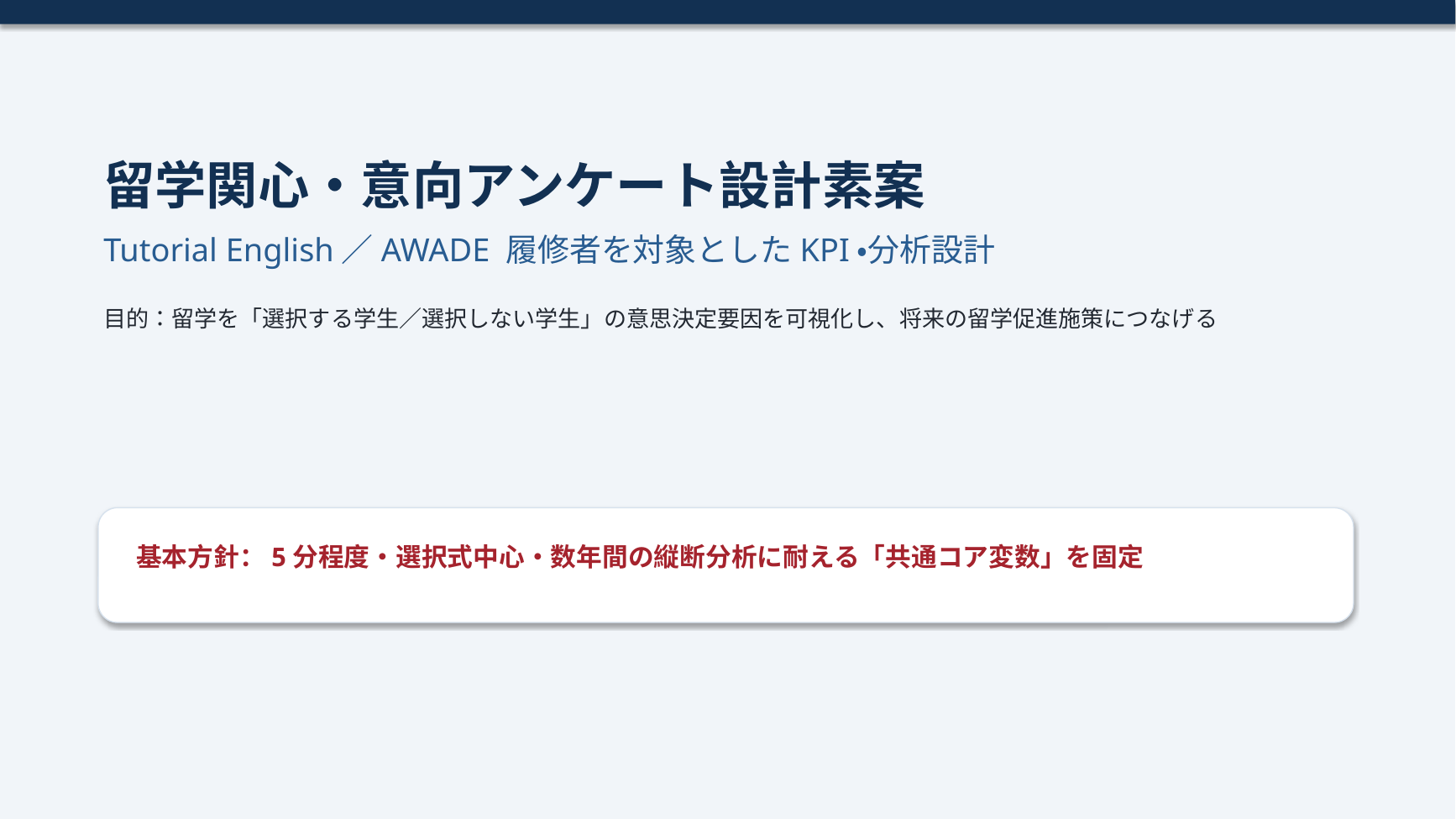
Survey Item Development and Analysis Design for Study-Abroad Interest among Waseda University Tutorial English / AWADE Students
Project Overview E-LINE will support Waseda University in developing questionnaire items and an analysis framework for Tutorial English / AWADE students. Rather than asking only whether students are interested in study abroad, the project is designed to visualize decision factors that distinguish students who choose study abroad from those who do not and to measure the process by which interest is converted into action.
Basic Policy To reduce respondent burden, the questionnaire is planned to take about five minutes and to consist mainly of closed-ended items. A set of common core variables will be kept as stable as possible so that the data can support longitudinal analysis across several years. The survey does not need to be identical to pre- and post-short-term-study-abroad questionnaires, but it will share core constructs such as self-efficacy, perceived value, and anxiety.
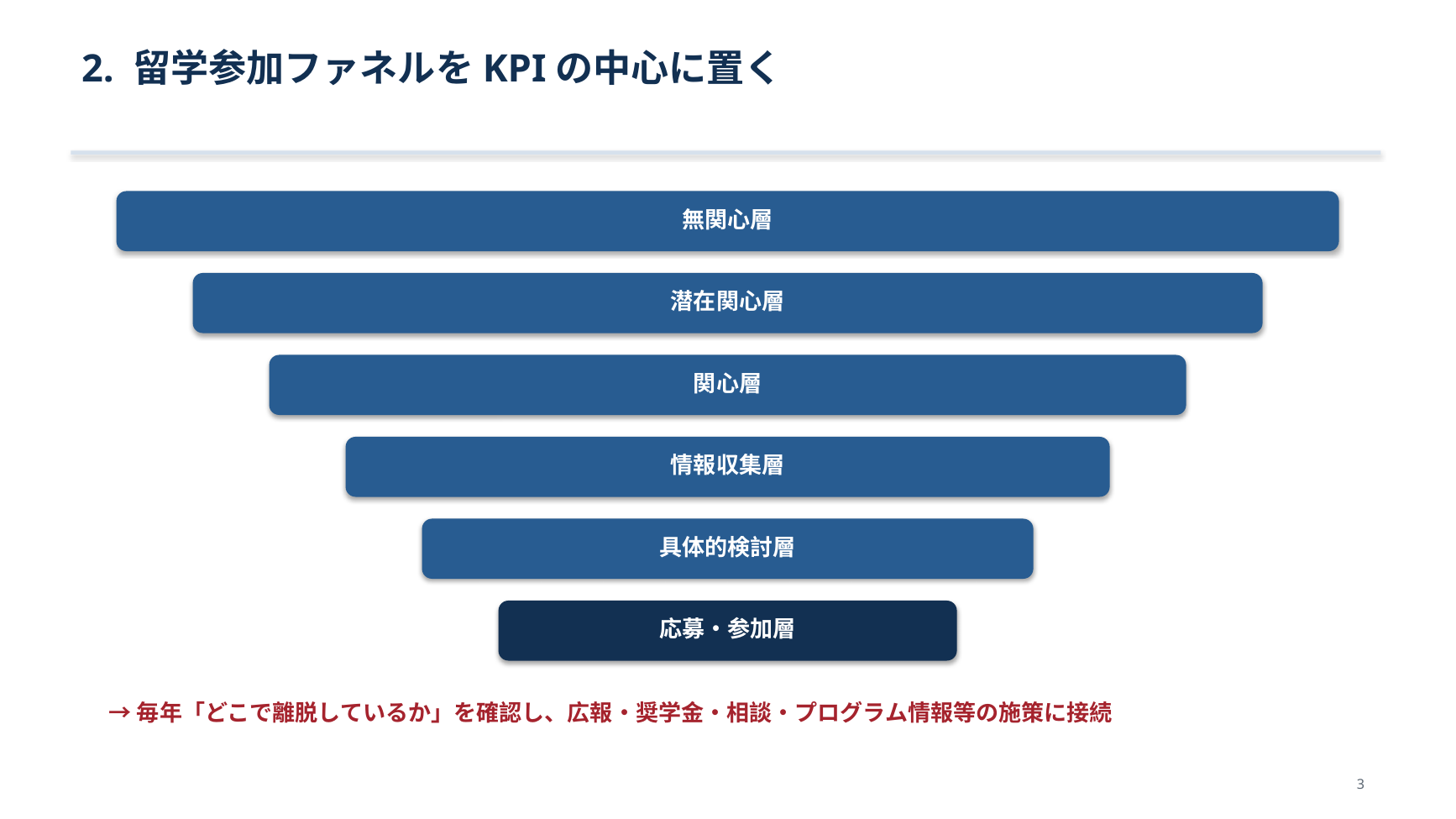
Placing the Study-Abroad Participation Funnel at the Center of the KPIs
Students who do not study abroad will not be treated as a single group. Instead, the design distinguishes stages such as uninterested, latent interest, interested, information seeking, concrete consideration, and application/participation. By checking each year where students tend to drop out of this funnel, the data can be connected to practical measures involving communications, scholarships, advising, and program information.
Ten Core KPIs
| 1 | Study-Abroad Interest Rate | Interest in study abroad |
|---|---|---|
| 2 | Study-Abroad Intention Score | Degree of actual desire to participate |
| 3 | Latent Study-Abroad Segment Rate | Share who would participate if conditions were favorable |
| 4 | Study-Abroad Self-Efficacy | Belief that study abroad is feasible for oneself |
| 5 | English Self-Efficacy | Confidence in learning and interacting in English |
| 6 | Perceived Value of Study Abroad | Perceived value for learning, career, and related outcomes |
| 7 | Barrier Index | Financial, language, curriculum, psychological, and other barriers |
| 8 | Information Sufficiency | Degree to which needed information is available |
| 9 | Behavioral Readiness | Information gathering, consultation, and concrete consideration |
| 10 | Actual Study-Abroad Conversion Rate | Share who later actually study abroad |
Recommended Structure for a Five-Minute Questionnaire
The basic format uses five-point scales plus multiple-choice items, with approximately one optional open-ended question. The proposed blocks are: (A) basic attributes, (B) English learning and English self-efficacy, (C) study-abroad interest, intention, and behavioral stage, (D) perceived value of study abroad, (E) study-abroad barriers, (F) information gathering and concrete actions, (G) needed support and information, and (H) an optional open-ended response.
Decision Factors Instead of asking a single question about “reasons for not studying abroad,” the survey separates perceived value, self-efficacy, psychological barriers, institutional/economic barriers, information barriers, and social influence. This makes it easier to distinguish genuinely uninterested students, students with latent interest, and students whose intention is being suppressed by barriers.
Analysis Design with Future Linkage to Actual Study-Abroad Participation
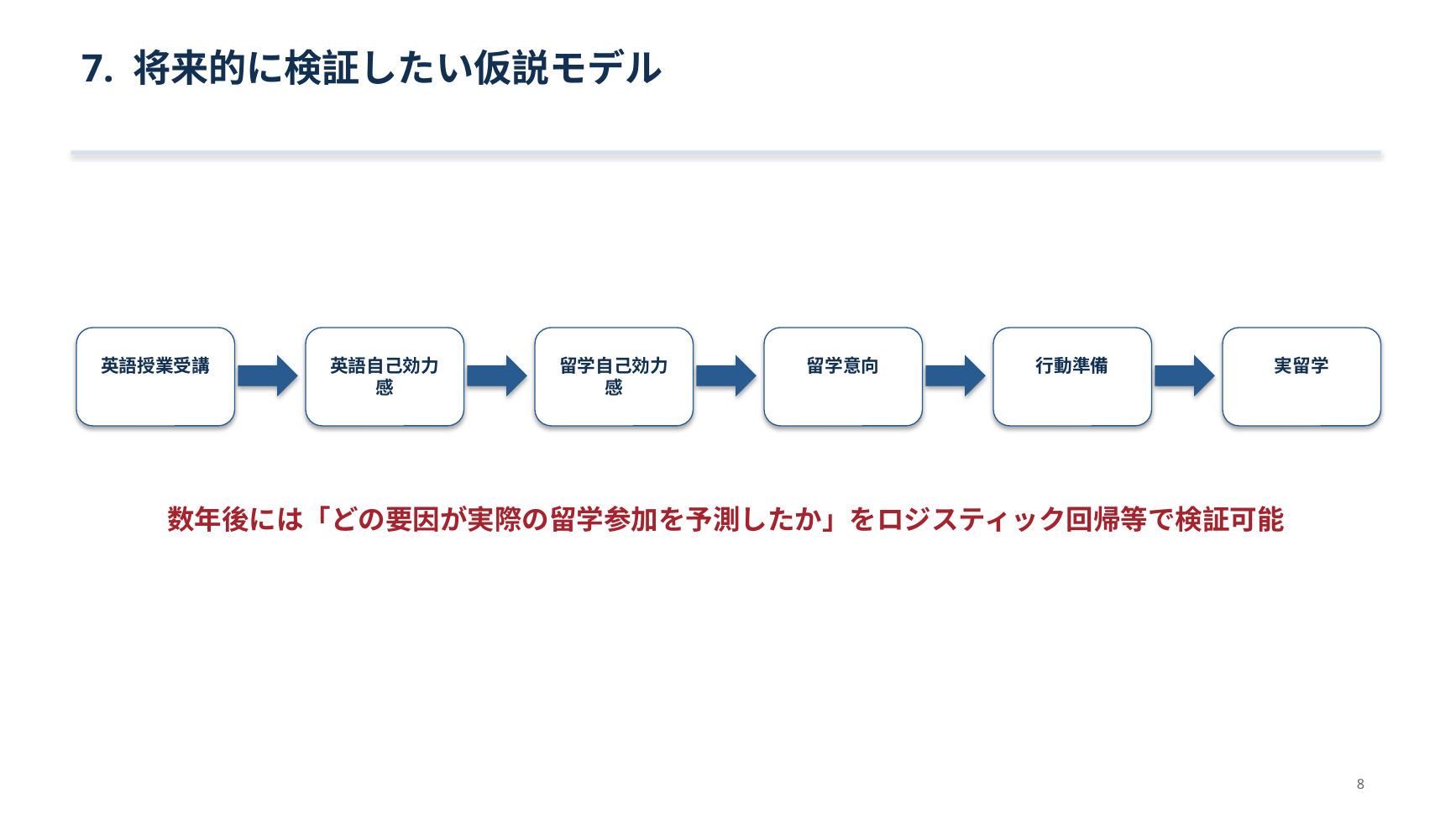
A future hypothesis model considers the sequence English-course participation → English self-efficacy → study-abroad self-efficacy → study-abroad intention → behavioral readiness → actual study abroad. From the first year, the design anticipates safe and appropriate linkage—using anonymized IDs where appropriate—between post-class survey data and later actual study-abroad records. Over time, this would make it possible to examine which factors predict actual participation using methods such as logistic regression.
About Causality This project establishes a survey and analysis foundation with the future examination of causal relationships in view. However, a single-wave observational questionnaire cannot by itself establish causality. The immediate goal is to build comparable measures and a longitudinal data structure, enabling later linkage to actual study-abroad records and examination of predictors through regression analysis. Strong causal inference requires additional design conditions, including temporal ordering, control of confounding factors, and appropriate comparison conditions.
Longitudinal Data Design for the Next Three to Four Years
The proposed data structure fixes fields such as Student ID (administrative side), anonymized analysis ID, Survey Wave, academic year, course, school/faculty, year of study, and Study Abroad Status. Question wording, response options, and scale direction should remain as stable as possible across years, with version control when changes are necessary. Rules governing purpose of use, storage, linkage, deletion, privacy, ethics, and internal university requirements should be clarified in advance.
Analysis Plan For a single year, descriptive statistics, KPI summaries, and cross-tabulation can be used to understand the distribution of student segments and barriers, while regression analysis can be considered where appropriate to examine associations with study-abroad intention and behavioral readiness. Once multiple years of data have accumulated, annual comparisons can be combined with the actual study-abroad conversion rate to build a data foundation that helps predict participation and improve interventions.
E-LINE will continue to support universities and research institutions across the full survey workflow, including clarification of research objectives and hypothesis models, KPI and student-segment definitions, questionnaire development, longitudinal data design, and analysis planning for descriptive statistics, cross-tabulation, and regression.
Hashtags
#WasedaUniversity #TutorialEnglish #AWADE #StudyAbroad #SurveyDesign #QuestionnaireDevelopment #KPI #LongitudinalAnalysis #EducationalResearch #SelfEfficacy #StatisticalAnalysis #UniversityResearchSupport
Related Information: Statistical Analysis & Analytics Services
Related Information: Contact Form
Contact Us
Please feel free to contact us using the information below.
