
Evidence Navigator Project Evidence Navigator Project
Evidence Navigator Project
For ingredients used in SPIC products, we comprehensively collect peer-reviewed papers, systematic reviews, guidelines, and other sources in Japan and overseas, assess their quality, and summarize the evidence to build a highly reusable evidence base that can be repurposed for marketing, regulatory compliance (Foods with Function Claims and public-facing communications), and materials for healthcare professionals.
Support Scope (Full Package)
1. Requirements Definition and Organization of the Main Claims/Hypotheses (Kickoff: 1.5–2 hours)
For each product and ingredient, we define the target function (outcome) and target population in PICO format.
Example: P (healthy adults / individuals with borderline obesity), I (ingredient X at Y mg/day), C (placebo / usual care), O (fatigue score, visual-function indicators, etc.).
We agree on market perspectives (points of differentiation) and wording considerations (permissible scope of efficacy/effect claims and prohibited wording).
2. Systematic Search Protocol Design (PRISMA-Compliant)
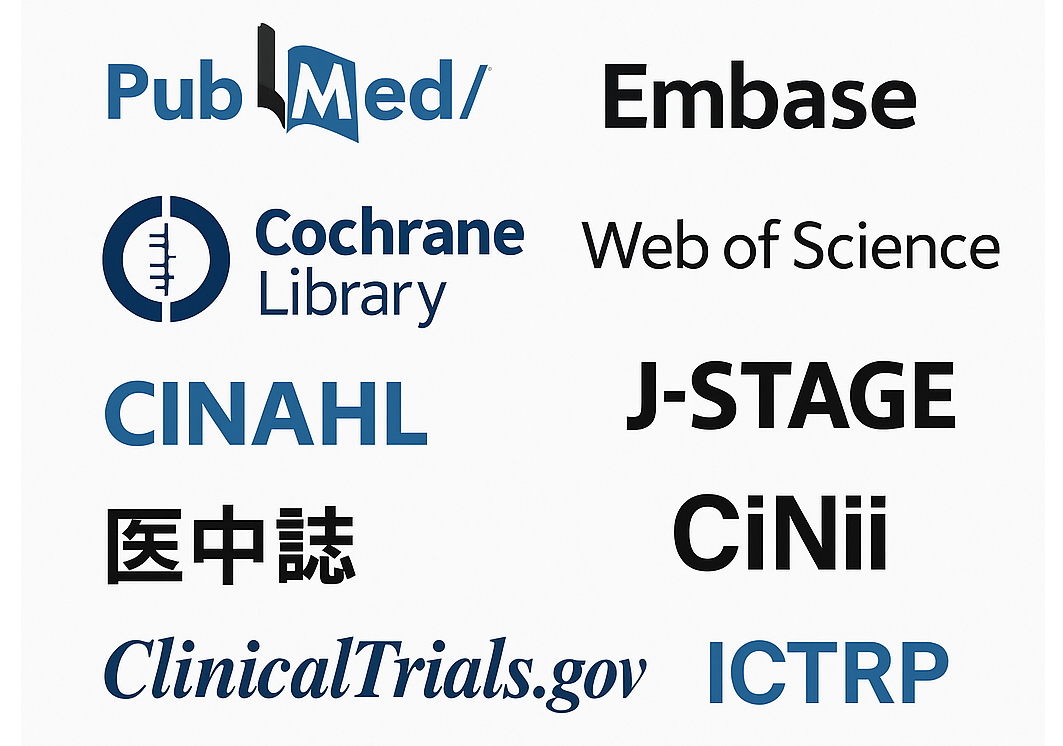
Databases and sources include PubMed/MEDLINE, Embase, Cochrane Library, Web of Science, CINAHL, J-STAGE, CiNii, Ichushi-Web, ClinicalTrials.gov, ICTRP, abstracts from major Japanese academic societies, and gray literature such as white papers and government publications.
Languages: Japanese and English as standard; Chinese and Korean can also be screened when required.
Search strategy design: for each ingredient, we create reproducible Boolean queries combining MeSH/Emtree terms and free-text terms, with version control.
Date range: as a rule, searches are conducted without a time restriction (from the earliest record to the latest), with optional supplementary searches limited to the past 10 years.
3. Screening (Two Stages, Including Deduplication)
Deduplication: records are normalized in Zotero/EndNote and identified using DOI/PMID.
Screening is conducted by two independent reviewers with mutual cross-checking: first-stage title/abstract review followed by second-stage full-text review.
Reasons for exclusion are recorded in the PRISMA flow to ensure auditability.
4. Quality Assessment & Risk-of-Bias Assessment
RCTs are assessed with Cochrane RoB 2, non-randomized studies with ROBINS-I, and observational studies with NIH/Joanna Briggs tools.
Evidence strength: an overall GRADE rating (high / moderate / low / very low) is assigned.
5. Data Extraction & Structuring
Using a predefined extraction sheet (Excel/CSV), we structure items including study design, participant characteristics, dose and duration, primary/secondary outcomes, statistical measures (effect size, confidence interval, p-value), adverse events, and conflicts of interest.
We create an outcome-specific evidence matrix (ingredient × outcome × population × quality).
6. Synthesis & Visualization
For sufficiently homogeneous groups of studies, we consider meta-analysis (fixed- or random-effects models) and create forest and funnel plots, after assessing feasibility and appropriateness in advance.
Where necessary, we assess heterogeneity (I², τ²) and conduct sensitivity analyses and subgroup analyses by dose, duration, age, sex, and other factors.
7. Preparation of Documents for Practical Use
Evidence summary (2–4 pages per ingredient): overview, recommended wording, cautions, and reference list.
Detailed report for HCPs (20–40 pages): search, selection, quality assessment, synthesis results, limitations, and interpretation.
Internal FAQ: anticipated questions and answer templates for sales promotion and customer support.
Regulatory & Wording Review / Guidance:
Assessment of whether claims are appropriate under Consumer Affairs Agency guidelines for Foods with Function Claims,
Alignment between the evidence and recommended intake amount,
Format for risk communication regarding interactions, contraindications, and precautions.
We provide a PRISMA flow diagram, search-strategy list, exclusion list, and audit log to ensure reproducibility.
8. Knowledge Management & Updates
We provide a shared Zotero library (tags: ingredient / outcome / design) and establish an operating system that can be updated as needed.
We offer quarterly or semiannual update searches for newly published evidence, as well as rapid-review slots when new outcomes are added.
Standard Categories When Ingredients Are Not Yet Specified (Examples)
Anti-fatigue and energy, sleep/stress, cognition and eye health, gut health (prebiotics/probiotics/postbiotics), metabolism and body composition, skin/beauty, cardiovascular support, and other areas.
* Priority outcomes are focused according to the actual formulation and intended claims.
Quality Assurance (QA) & Governance
We use double screening and quantitatively manage inter-rater agreement with the kappa coefficient (target benchmark: ≥0.70).
Important decisions, including inclusion/exclusion and reasons for downgrading GRADE, are recorded in a decision log so they can be re-examined.
Generative AI is limited to an auxiliary role (e.g., candidate summaries); verification against original sources and human review are mandatory.
We comply with non-disclosure agreements (NDAs) and strictly manage restrictions on taking data off-site and version control.
Contact Us
Please feel free to contact us using the information below.
