
Tojisha-Kenkyu Project Participant Research Project
Tojisha-Kenkyu by and for People with Developmental Disabilities
E-LINE Co., Ltd. provided qualitative-analysis support using M-GTA (Modified Grounded Theory Approach) in connection with “Tojisha-Kenkyu by and for People with Developmental Disabilities,” led by the Kumagaya Laboratory (COPRO) at the Research Center for Advanced Science and Technology, The University of Tokyo.
Since 2011, the Kumagaya Laboratory has continuously held Tojisha-Kenkyu meetings in which people with developmental disabilities themselves take the lead as researchers and discuss practical ways of living and the difficulties they face. Cumulative participation has exceeded 2,700 people, and the recorded narratives constitute a valuable research resource for reconsidering developmental disabilities from the perspective of the social model. The meetings incorporate distinctive formats such as “speak freely and listen without interruption” and “drop-in Tojisha-Kenkyu,” and research findings are returned to society through manuals and videos.
E-LINE was responsible for qualitative-analysis support using M-GTA to theorize the experiences contained in this extensive body of narratives and extract new insights. M-GTA is a method that generates concepts grounded in field data and clarifies relationships among categories, making it well suited to systematizing the difficulties and coping strategies of people concerned within their social context. Based on specific episodes described by participants, E-LINE’s analysis team extracted the “structure of difficulties” and “processes of coping,” then compared and integrated them to help develop accumulated Tojisha-Kenkyu findings into more broadly applicable knowledge.
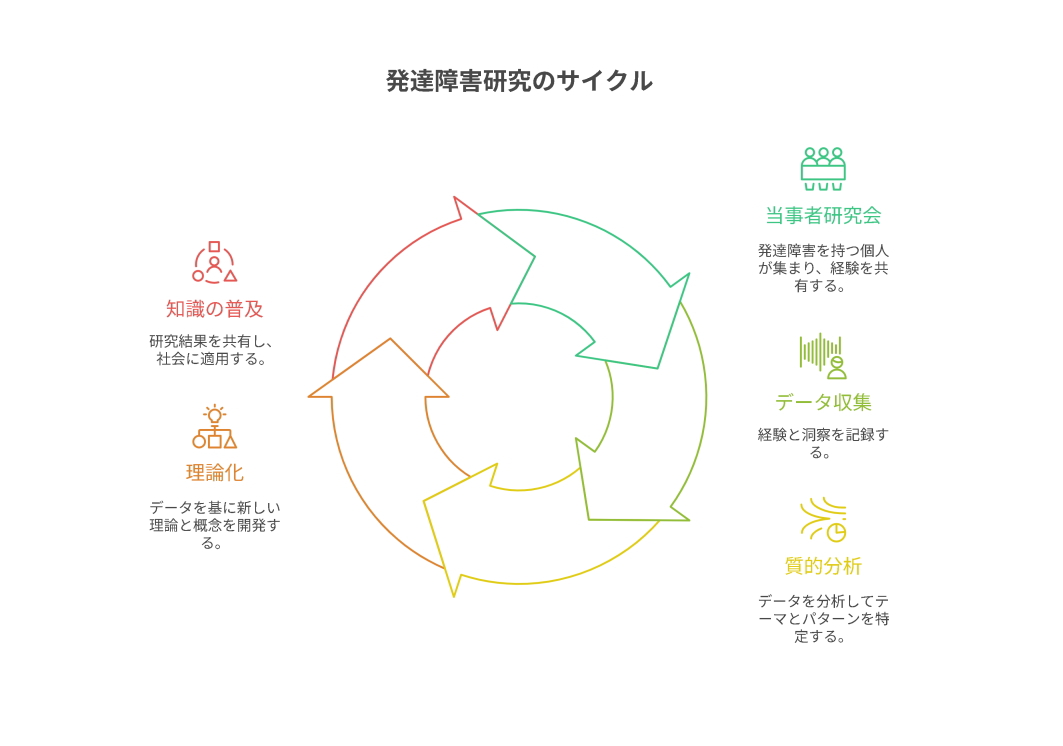
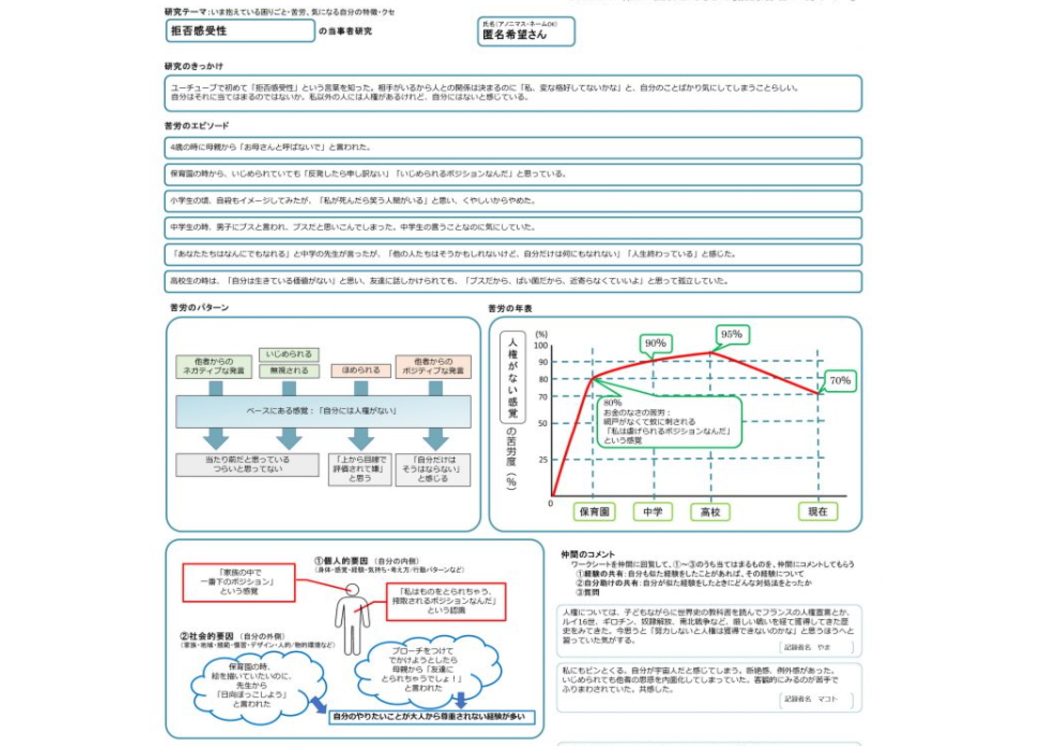
This analytical support also helped organize new concepts and phrases generated by participants and present them in the form of hypotheses. In addition, the Kumagaya Laboratory developed visualizations of qualitative data and explanatory materials so that research findings could be applied in companies, educational settings, and welfare practice. We believe this contributed to building a foundation for Tojisha-Kenkyu to develop beyond a method of self-help into an approach to coexistence and organizational change across society.
E-LINE intends to continue supporting the discovery of important information embedded in text data and to serve as a bridge connecting qualitative data, research, and society.
Reference: https://otoemojite.com/
Contact Us
Please feel free to contact us using the information below.
