
Corporate Website English and Chinese Translation Project Corporate Website Translation Project into English and Chinese
Corporate Website English & Chinese Translation Project
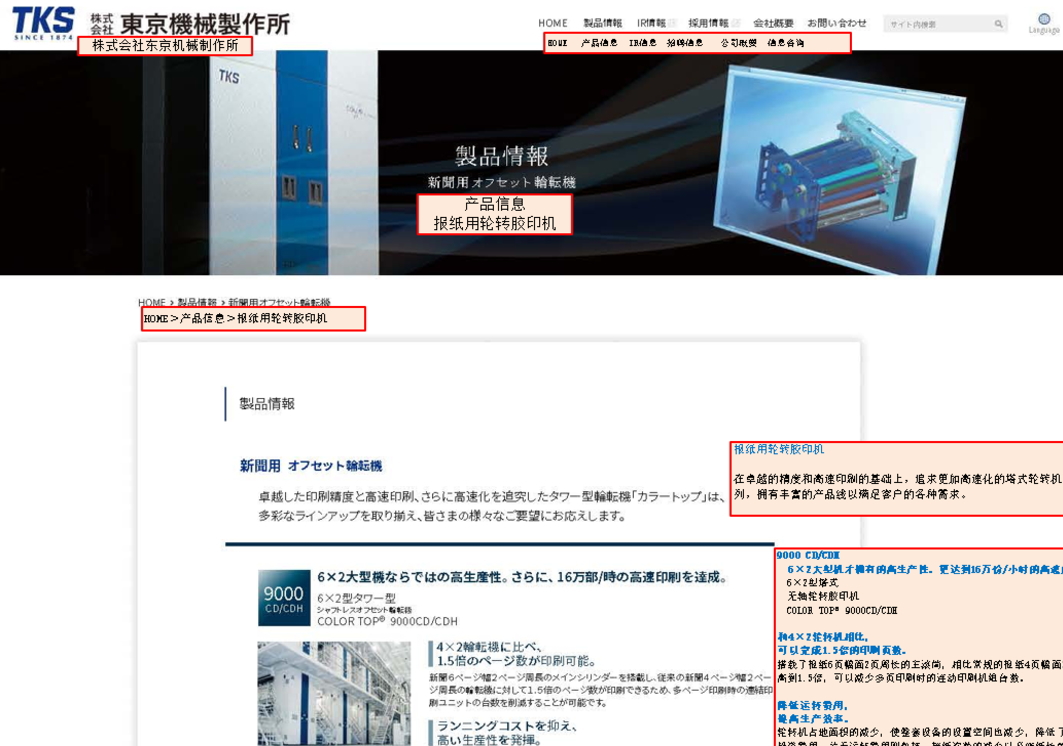
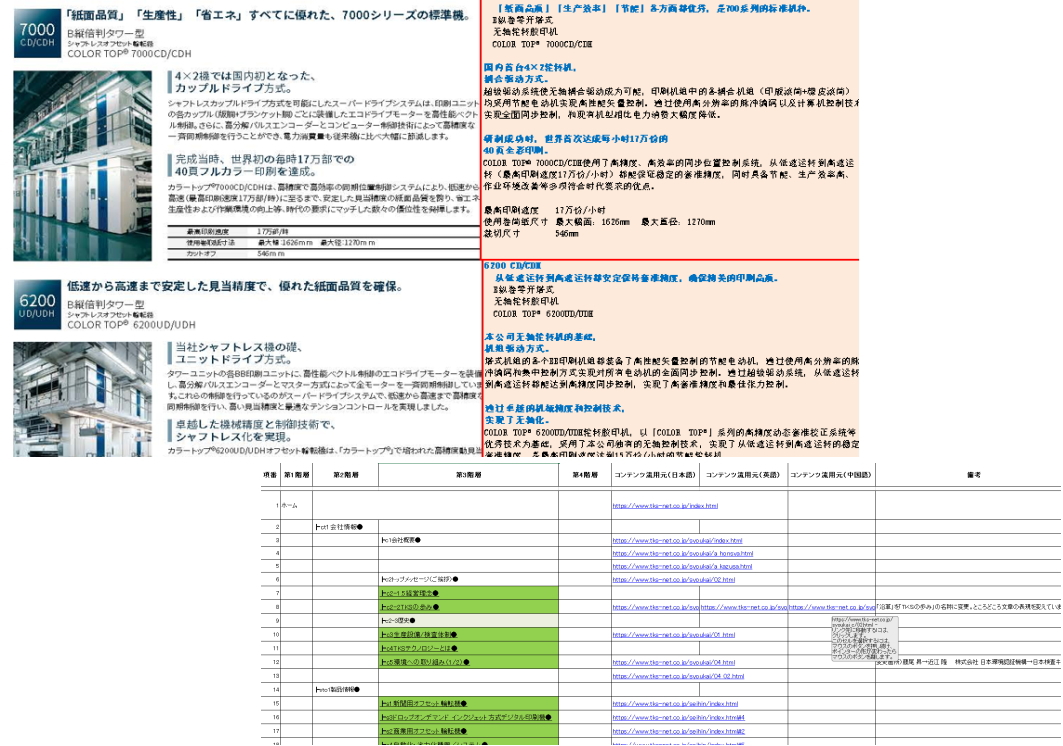
This project was conducted to strengthen the global accessibility of Tokyo Kikai Seisakusho, Ltd. (TKS) by translating major sections of its corporate website into English and Chinese. The translation scope covered three areas—Product Information, Corporate Information, and IR Information—with the target text clearly marked by red circles in the supplied screen materials. E-LINE accurately mapped the information structure and prepared a terminology list and style guide to achieve consistent wording in English and Chinese.
1. Organizing the Translation Scope
The product-information section included categories such as newspaper web-offset presses, commercial web-offset presses, and digital printing presses, as well as product series including “COLOR TOP,” “COLORMASTER,” “ECONOMASTER,” and “JETLEADER.” Highly distinctive product names and model numbers were retained in their original form in both English and Chinese. Category names and descriptive labels, by contrast, were rendered in natural English and concise, easily understood Chinese.
The corporate-information section covered items such as “Top Message,” “Management Philosophy,” “Corporate History,” “TKS History,” “Production Equipment,” “Inspection System,” “Access,” and “Environmental Initiatives.” English terminology was primarily aligned with labels in the materials provided, such as “Corporate Profile,” “Management Philosophy,” “Development,” and “History,” while Chinese terminology used standard expressions that would be intuitive to investors and business partners.
The IR section included items such as “Financial Information,” “Stock Information,” “Electronic Public Notices,” “Corporate Governance,” “Business Reports,” “General Meetings of Shareholders,” “Securities Reports,” and “Timely Disclosure Information.” For English, internationally standardized expressions such as “Financial Information,” “Corporate Governance,” and “Timely Disclosure Information” were adopted.
2. Translation Policy & Terminology Standardization
We adopted the following basic translation policies.
Proper nouns, including product names, series names, and model numbers, were retained in their original form.
English terminology was standardized throughout based primarily on labels provided in the source materials.
Simplified Chinese was used as the standard, with intuitive industry-standard terminology.
UI labels were standardized across breadcrumbs and navigation so that terminology would remain consistent in both English and Chinese.
This policy enabled multilingual site terminology that is internationally appropriate while remaining easy for users to understand.
3. Quality Assurance (QA) Framework
Because the site contains mainly short UI text, translation consistency and on-screen readability were especially important. We therefore thoroughly implemented: (1) a glossary and bilingual terminology list, (2) placement checks on wireframes, (3) mutual review of the English and Chinese versions, and (4) consistency checks across navigation. In particular, every translation target marked with a red circle in the supplied materials was translated without omission and annotated to correspond with the relevant screen capture.
Contact Us
Please feel free to contact us using the information below.
